
Conference Intelligence: How Medical Affairs and Commercial Teams Can Maximize Value Across the Conference Lifecycle
Conference intelligence is the structured process of identifying, capturing, and analysing data from medical congresses — before, during, and after the event. It enables life sciences organizations to transform conference participation into informed decisions, stronger competitive intelligence, and measurable business value.
Friday, June 12, 2026
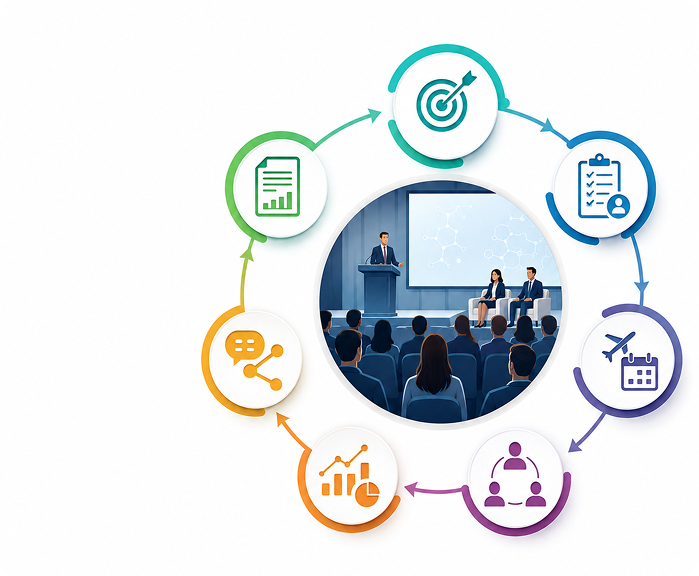
What is Conference Intelligence?
What you expected
pre-congress signals, planned sessions, competitor activity to watch
What you observed
live insights, KOL commentary, scientific shifts, competitive moves
What you act on
post-event decisions, updated engagement strategies, revised commercial positioning
Why Conference Intelligence Matters
The volume, pace, and complexity of medical congresses has grown significantly. Global and regional events now run year-round across every major therapeutic area. MSL bandwidth is finite. Compliance requirements around HCP engagement are tightening. And competitors are increasingly sophisticated in how they use congress data to shape scientific narrative and market positioning.

Against this backdrop, medical conference intelligence has become a defining operational capability for high-performing teams. Here is why:
The Stakes of Missing a Signal
MSL Coverage at Scale
Conference KPIs Are Now Boardroom Metrics
Pre-Conference Analytics
Effective pre-conference intelligence enables teams to arrive with clear priorities rather than spending valuable time deciding where to focus.
Key benefits:
- Reduced time spent on manual research and last-minute planning.
- Improved alignment between congress activities and organizational priorities.
- Greater confidence in identifying competitive opportunities and risks.
Live and On-Site Intelligence Capture
Capture critical scientific and competitive insights as they emerge, ensuring valuable conference learnings are recorded and shared in real time.
Key benefits:
- Capture high-value scientific and competitive insights in real time.
- Document key KOL perspectives and congress learnings in a structured format.
- Reduce the risk of missed or fragmented insights.
Post-Conference Analytics
The value of a congress extends well beyond its closing session. Post-conference analytics transform event learnings into strategic actions.
Key benefits:
- Clear understanding of how the scientific landscape has evolved.
- Stronger KOL engagement strategies based on the latest insights.
- Better prioritization of future scientific and business initiatives.
1. Discover and track relevant upcoming congresses both global and regional well in advance, with lead time to plan participation efficiently.
2. Request structured pre-conference analytics reports.
3. Capture insights during the event in a structured format, all in one place, eliminating scattered inputs.
4. Access comprehensive post-conference analytics report that synthesise on-the-ground capture with full-congress data coverage.
Ready to build a conference intelligence system that works across your entire congress calendar?
Conference intelligence helps Medical Affairs teams make more informed decisions before, during, and after medical congresses. It improves strategic planning, strengthens KOL engagement, provides timely scientific and competitive insights, and enables teams to maximize the value of every conference.
Competitive intelligence provides a broad view of the market and competitor activities across multiple sources. Medical conference intelligence, on the other hand, focuses specifically on scientific, clinical, and competitive insights generated around medical congresses, helping life sciences teams make timely, informed decisions before, during, and after the event.
Pre-conference analytics helps teams prepare strategically before a congress, enabling them to prioritize opportunities, optimize engagement plans, and enter the event with greater confidence. Post-conference analytics helps life sciences teams assess outcomes, uncover key insights, measure scientific and competitive shifts, and translate learnings into informed business decisions and future engagement strategies.
Yes. It helps life sciences teams stay ahead by tracking upcoming medical conferences and providing early visibility into relevant events, allowing them to plan, prioritize, and prepare well before the congress begins.
A strong vendor covers the full conference lifecycle: pre-conference baselining, live session capture, and post-congress reporting with actionable recommendations. What sets a good vendor apart is analytical judgment: identifying which abstracts, competitive shifts, and KOL signals genuinely matter, rather than simply delivering raw data.